
What Is Built on OP Mainnet and the OP Stack? An Ecosystem Overview of Chains, Apps, and Stats
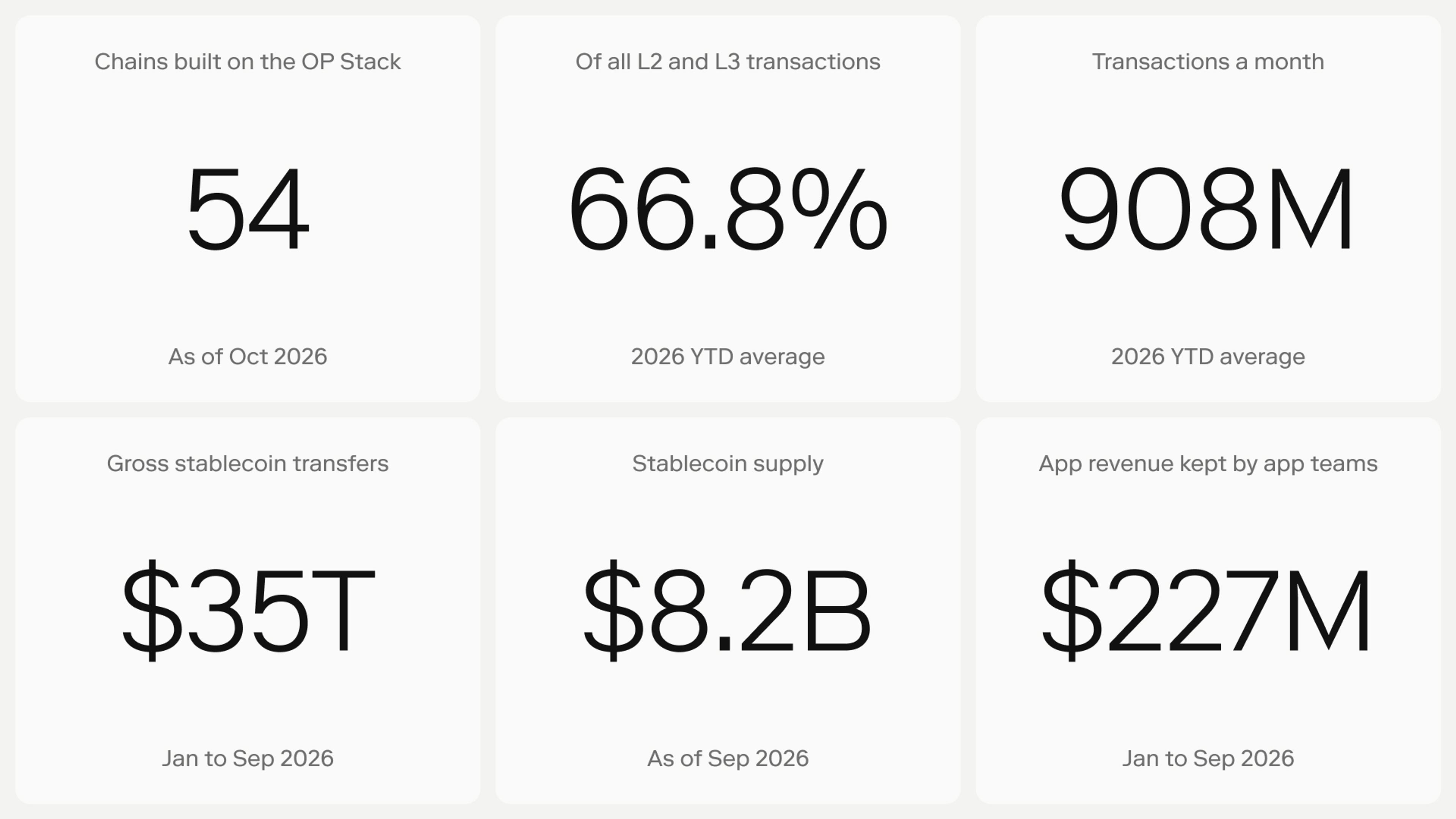
TL;DR: As of October 2026, 54 mainnet chains are built on the OP Stack, and they handled 66.8% of all Layer 2 and Layer 3 transactions in an average month of 2026.
- The ecosystem averaged 908 million transactions a month and settled $35 trillion in gross stablecoin transfers from January to September 2026.
- Named deployments range from Soneium Foundation and World to a managed chain in Ink, plus consumer and tokenized-asset products on OP Mainnet.
- Korean institutions and Toss are earlier, at test, MOU, or testnet stages.
Optimism publishes the numbers behind the OP Stack on one stats page. This overview maps those figures to the chains, applications, and operating models behind them, so a reader can see the ecosystem at its actual size and check each claim against a dated source.
How big is the OP Stack ecosystem in October 2026?
54 mainnet chains are built on the OP Stack as of October 2026, according to Optimism's stats page. OP Stack chains handled 66.8% of all Layer 2 and Layer 3 transactions in an average month of 2026 so far. They averaged 908 million transactions a month from January to September.
| Metric | Figure | Period and definition | Source |
|---|---|---|---|
| Mainnet chains built on the OP Stack | 54 | As of October 2026 | Optimism stats page |
| Share of L2 and L3 transactions | 66.8% | Average of monthly shares, January to September 2026, weighted by transaction count | Optimism stats page (Dune Analytics, Goldsky, L2BEAT, growthepie) |
| Monthly transactions | 908 million | 2026 year-to-date monthly average, including reverted transactions | Optimism stats page |
| Stablecoin recorded volume | $35 trillion | Gross USD-pegged stablecoin transfers, excluding mints and burns, January to September 2026 | Optimism stats page (Dune Analytics) |
| Stablecoin supply | $8.2 billion | End of September 2026 | Optimism stats page (DefiLlama, L2BEAT) |
| Assets active in DeFi | $7.5 billion | End of September 2026 | Optimism stats page (DefiLlama) |
| Total value secured | $22.2 billion | September 2026 | Optimism stats page (L2BEAT) |
| Application revenue kept by app teams | $227 million | January to September 2026, excluding chain fees | Optimism stats page (DefiLlama) |
Teams deploy and operate their own OP Stack chains, so the chain count says how widely the technology is used. It does not say how many chains Optimism operates.
OP Stack share of L2 and L3 transactionsShare of monthly L2 and L3 transactions handled by OP Stack chains.
| Label | Apr '25 | May '25 | Jun '25 | Jul '25 | Aug '25 | Sep '25 | Oct '25 | Nov '25 | Dec '25 | Jan '26 | Feb '26 | Mar '26 | Apr '26 | May '26 | Jun '26 | Jul '26 | Aug '26 | Sep '26 |
|---|---|---|---|---|---|---|---|---|---|---|---|---|---|---|---|---|---|---|
| OP Stack share of L2 and L3 transactions | 62.7% | 66.9% | 68.3% | 63.9% | 66.7% | 72.8% | 69.6% | 71.4% | 69.3% | 70.6% | 64.9% | 60.7% | 64.4% | 70.2% | 76% | 63.5% | 64.9% | 64.6% |
Which chains are built on the OP Stack?
The stats page currently lists 54 chains, and the list is subject to change. The examples below are the ones with a public Optimism source on who is behind them. Each chain is operated by its own team unless noted.
| Chain | Who is behind it | Operating model and stage |
|---|---|---|
| Soneium Foundation | Soneium Foundation | Self-operated OP Stack chain, announced August 2024 |
| World | World (see the Optimism case study) | Self-operated OP Stack chain |
| Ink | Managed by Optimism through OP Enterprise | Fully Managed |
| Unichain | Listed on the stats page | Self-operated OP Stack chain |
| GIWA | Dunamu, the company behind Upbit | Self Managed OP Enterprise, testnet |
| Vision Chain | Bitpanda | Fully Managed OP Enterprise, mainnet planned for the second half of 2026 |
The 54-chain count comes from the stats page and includes chains at different stages of activity, so it measures deployment breadth. It is not a count of chains in active institutional use.
Which applications and assets are live on OP Mainnet?
OP Mainnet is the public, permissionless network. Teams can deploy applications there with no chain to run. Several products already do.
| Deployment | What it is | Public detail and source |
|---|---|---|
| ether.fi Cash | Crypto card product | More than 100,000 active cards and more than 300,000 accounts (Optimism, August 13, 2026) |
| Zipangcoin | Tokens backed by physical gold, silver, and platinum, issued by Mitsui & Co. Digital Commodities | Launched April 2026 (Optimism, May 19, 2026) |
| mRe7ETH | ETH-denominated product from Re7 Labs, offered through Midas | Launched April 2026 (Optimism, May 19, 2026) |
| Morpho | Lending protocol | Optimism case study |
| Velodrome | Decentralized exchange | Optimism case study |
Zipangcoin shows a pattern worth noting: a subsidiary of a Japanese trading house issued a commodity-backed asset on a shared public network instead of building its own chain.
The third-party products named above are applications that are not owned or controlled by the Optimism Foundation. This overview is for informational purposes only and is not an endorsement or a solicitation to invest your own capital. Participation in digital asset protocols is risky, so please conduct your own careful due diligence before use.
Which operating models do these deployments use?
The product types differ widely: consumer cards, commodity-backed tokens, exchange chains, and DeFi. The operating models differ too.
| Operating model | Examples | What the team keeps |
|---|---|---|
| Shared public network (OP Mainnet) | ether.fi Cash, Zipangcoin, mRe7ETH, Morpho, Velodrome | The product and its application-level controls. No chain infrastructure to run |
| Self-operated OP Stack chain | Soneium Foundation, World, Unichain | Full control of the chain, run by the team that deployed it |
| OP Enterprise, Self Managed | Dunamu (GIWA) | Chain infrastructure in its own cloud, with Optimism support |
| OP Enterprise, Fully Managed | Ink, Bitpanda (Vision Chain) | Chain configuration and economics. Optimism deploys, operates, and upgrades the infrastructure |
No model is better than another in general. A shared network has no chain to stand up, so it typically reaches production sooner. A dedicated chain adds capacity, configuration, and economics the operator controls, in exchange for more setup.
What is still in test or announced?
Three Korean efforts are still in pre-production. Toss and KOMSCO completed a load, spend, and settle test in September 2026 in a separate test environment, with no go-live date. KB Securities signed an MOU on September 21, 2026 with Securitize and the Optimism Foundation to explore tokenized fund offerings planned for OP Mainnet. DB Securities has announced a two-year phased build. These are statements of intent or tests, so they sit at the earliest stages.
What should a buyer ask before relying on a reference?
Four questions separate a live deployment from a headline.
- What stage is it in: production, test, or MOU?
- Who operates the infrastructure?
- Is the metric dated, and is the source the partner or Optimism?
- Does the reference match the product you plan to build?
Volume and TVL figures change quickly, so check the dated figures on Optimism's stats page before quoting them.
Frequently Asked Questions
How many chains are built on the OP Stack?
54 mainnet chains have been built on the OP Stack as of October 2026, per Optimism's stats page. Teams deploy and operate their own chains. OP Enterprise also offers a Fully Managed option, in which Optimism operates chain infrastructure as a service for the chain's owner.
What share of Layer 2 transactions run on the OP Stack?
OP Stack chains handled 66.8% of all Layer 2 and Layer 3 transactions in an average month of 2026 so far, using monthly data from January to September. The figure is weighted by transaction count.
Which companies are live on OP Mainnet?
ether.fi Cash, Zipangcoin from Mitsui & Co. Digital Commodities, Re7 Labs' mRe7ETH, Morpho, and Velodrome are live on OP Mainnet. Soneium Foundation, World, and Unichain are chains built on the OP Stack, and Ink is managed through OP Enterprise.
Is Toss live on the OP Stack?
No. Toss and KOMSCO completed a load, spend, and settle test in September 2026 in a separate test environment. No go-live date has been announced.
What is the difference between OP Mainnet and OP Enterprise?
OP Mainnet is a shared public network where a team deploys an application with no chain to run. OP Enterprise gives a business a dedicated chain, either Self Managed or Fully Managed.
Where can I find current volume and TVL figures?
Optimism publishes dated network metrics on its stats page. Treat any figure without a date as unverified.
Glossary
- OP Stack: The open-source, MIT-licensed technology that Ethereum Layer 2 chains are built on.
- OP Mainnet: Optimism's public Ethereum Layer 2, a shared network for deploying applications without running a chain.
- OP Enterprise: Optimism's commercial product for dedicated chains, offered as Self Managed and Fully Managed tiers.
- MOU: A memorandum of understanding, a statement of intent that is not a launch.
- Testnet: A test network that mimics a production chain without real assets.
- TVL: Total value locked, the assets deposited in a protocol or network.
Key sources
- Optimism stats page, October 2026
- Optimism case studies
- Optimism: ether.fi upgrades to Aave V4 on OP Mainnet, August 13, 2026
- Optimism: OP Mainnet's Growing Role in Onchain Finance, May 19, 2026
- Optimism: Mitsui & Co. Digital Commodities launches Zipangcoin on OP Mainnet
- Optimism in Korea: the partners, the proof, and where to find us at KBW, August 10, 2026
- Optimism: Bitpanda launches Vision Chain as the first Fully Managed OP Enterprise chain
- OP Enterprise product page
- DigitalToday: KB Securities joins Securitize, Optimism to pursue STO business for institutions
Authored by

Optimism